Robotic Vacuum Cleaners: The Growth Engine of the Smart Home Market

Robotic Vacuum Cleaners: The Growth Engine of the Smart Home Market
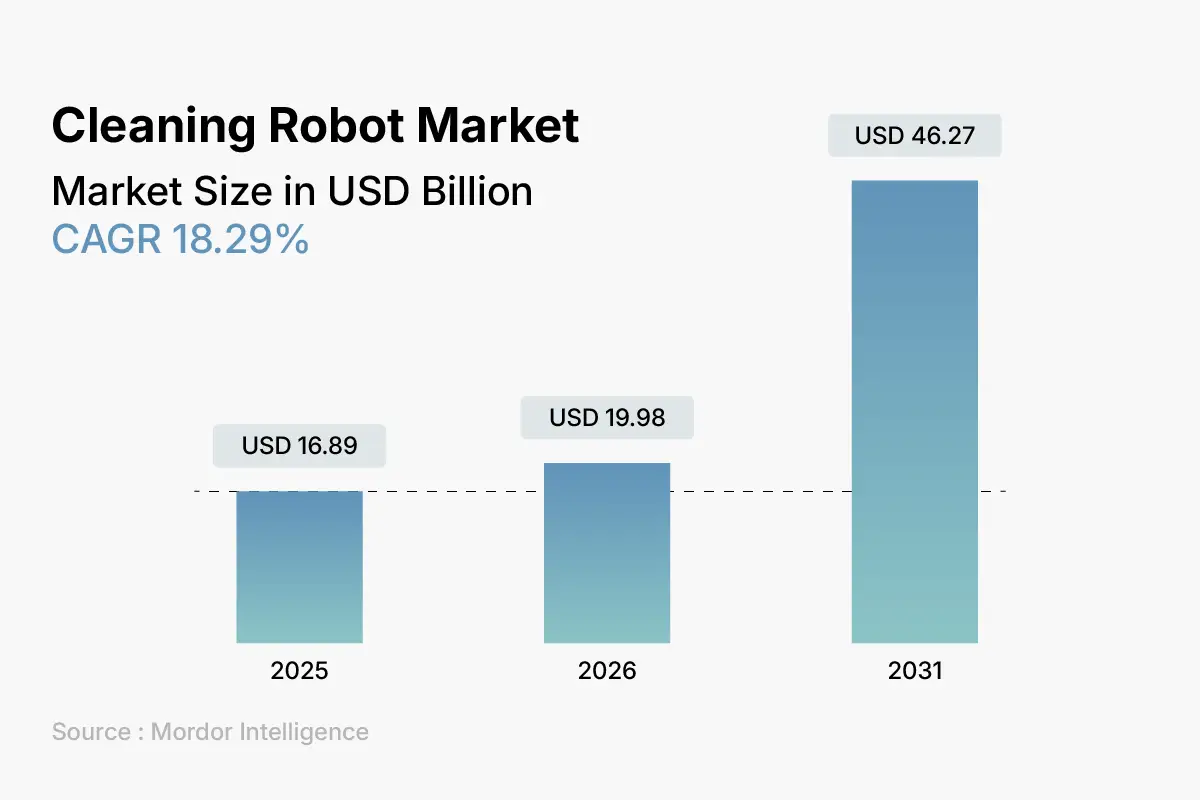
According to the latest IDC (Q3 2025) Worldwide Quarterly Smart Home Device Tracker, robotic vacuum cleaners are reshaping the market landscape at a staggering pace. With GII forecasting a compound annual growth rate of 18.29% over the next five years, the sector shows strong momentum. Indeed, 2025 shipments have already surpassed 17.42 million units, marking a significant 18.7% year-over-year increase.
In an increasingly saturated home appliance market, robotic vacuum cleaners are evolving through the deep integration of AI. Beyond mere cleaning, today's robots are intelligent, context-aware systems built to understand and navigate complex home environments.
I. The Technological Evolution of Robotic Vacuum Cleaners: From Mechanical Logic to AI Vision
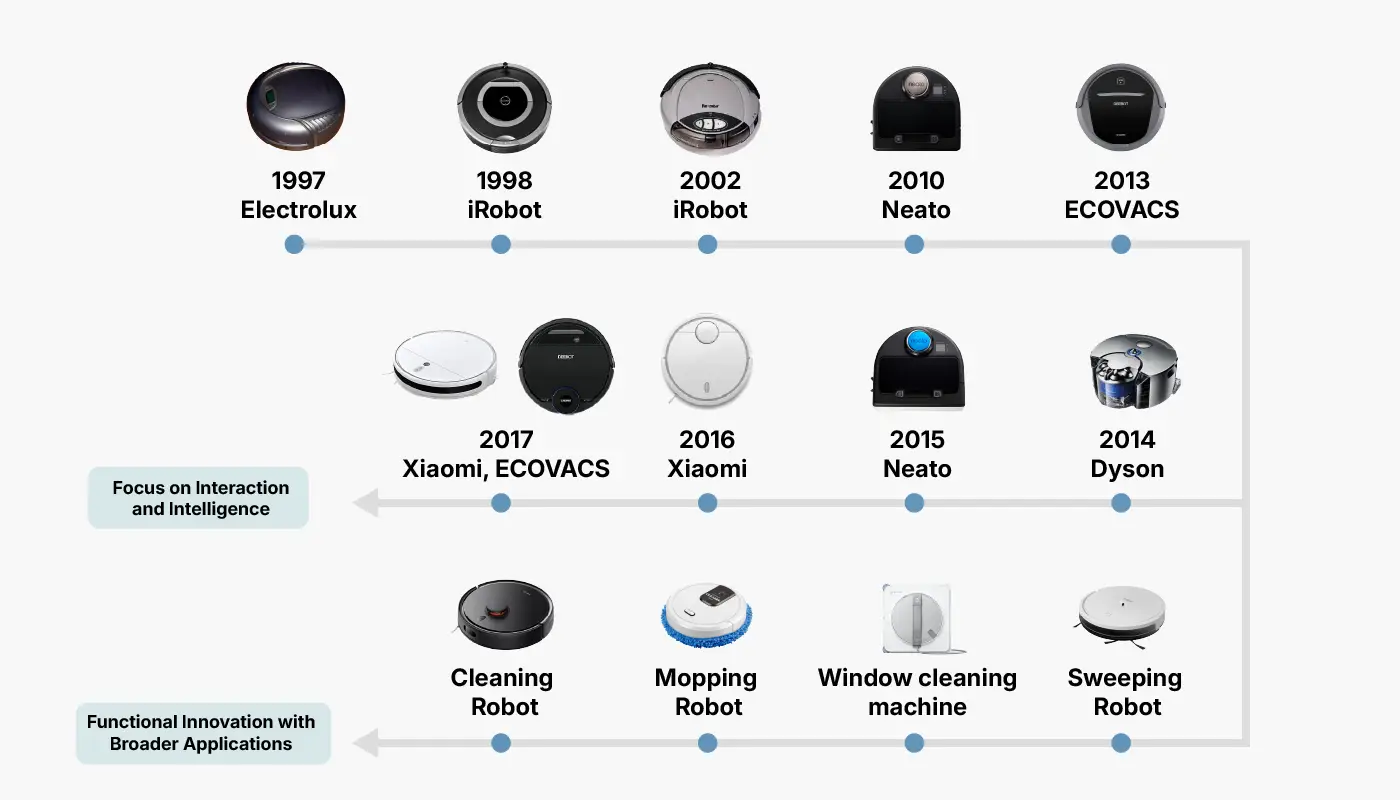
To navigate today’s technical complexities, we must first trace the pivotal industry milestones that have shaped the past three decades.
The Inception Phase (1997 – 2010): The Birth of Robotic Vacuum
The journey began in 1997 when Electrolux unveiled the Trilobite, the industry’s first conceptual robotic vacuum cleaner. This era relied on physical bumper sensors and basic infrared obstacle avoidance, with a primary focus on achieving "Auto-Docking" for independent operation.
Breaking the Barrier (2010 – 2020): The Navigation Revolution
Neato and iRobot pioneered LiDAR and SLAM, enabling robots to perform simultaneous mapping and path planning. Subsequently, industry giants like Xiaomi and Ecovacs accelerated technology democratization, making high-precision LiDAR a market standard and officially ending the era of "random bounce" cleaning.
Marching into the Intelligence Era (2020 – 2025): Multi-Sensor Fusion & Deep AI
As robotic vacuum cleaners entered the intelligence era, dToF and structured light technologies began to supersede traditional laser methods. This technological leap, combined with advanced AI, allows robots to identify and navigate household objects with pinpoint accuracy and sub-millimeter precision.
Beyond the Floor (2026+): The Rise of All-Terrain Service Robots
The emergence of dual-wheel-leg and tracked structures at Consumer Electronics Show 2026 has pushed the boundaries of domestic robotics. As robots transition to all-terrain environments, the reliance on high-fidelity optical sensing has intensified. Success now depends on shifting from simple 2D mapping to comprehensive 3D spatial judgment, requiring the type of millimeter-level accuracy that ensures stability during vertical transitions.
II. Core Function Analysis: Defining Optical Solutions for Next-Gen Robotic Vacuum Cleaners
As a global leader in optical innovation, Edison Opto provides the high-precision sensing foundation for the robotic vacuum cleaner market. Our technologies power the three essential pillars of next-generation robotic performance.
1. Spatial Modeling: Millimeter-Level Precision Mapping
Modern robots require millisecond-level modeling to navigate complex, dynamic environments.
Collision Sensing | Zero-Latency Feedback
Using Photo Interrupter (ITR) Sensors (such as Edison’s ITR series, SMD/DIP type) with slot widths from 1mm to 5mm, we ensure "zero-latency triggering" across various shutter designs to capture every physical interaction accurately.
dToF Scanning | Preventing Collisions
The EDTOF4424 solution maintains a minimal error margin of <3% within a 2cm to 500cm range, a precision level pivotal for the 2026 emergence of stair-climbing robotics. Its short-range detection enables 'zero-collision' proximity cleaning, while its long-range sensing allows the robot to preemptively identify and bypass obstacles for a seamless navigational experience.
AI Visual Lighting | Transcending Low-Light Limitations
The EDILON3838 series serves as the critical illumination engine for AI vision. By providing high-power infrared output, it ensures cameras can accurately delineate obstacle boundaries, optimizing recognition algorithms in extreme low-light or zero-light conditions.
2. Extreme Environment Protection: Defining the Zero-False-Positive Benchmark
As robots gain climbing capabilities, cliff detection has become a paramount safety feature.
Edison’s high-performance sensing architecture combines 20° narrow-angle CHIP IR LEDs with precision phototransistors. This configuration optimizes beam intensity, delivering a superior SNR that guarantees absolute stability and "zero-false-positive" cliff detection across diverse and challenging terrains.
3. Intelligent Navigation: High-Efficiency Recharging & Alignment
Empowering the last mile of autonomy, high-reliability CHIP IR LEDs ensure every docking is performed with absolute precision.
Edison leverages dual-configuration IR LEDs, and combines 120° wide-angle scanning with 20° narrow-angle alignment to significantly maximizes docking success rates, eliminating the friction of charging failures and guaranteeing a seamless power lifecycle.
III. Future Outlook: Navigating All-Terrain Challenges (Insights from Consumer Electronics Show 2026)
Consumer Electronics Show 2026 showcased a new frontier where robotic vacuum cleaners with vertical mobility and obstacle-leaping capabilities took center stage. This signals a paradigm shift in sensing: an evolution from 2D “static avoidance” to 3D “dynamic environmental intelligence.”
As devices navigate staircases and thresholds, factors such as instantaneous response speed, ambient light immunity, and ultra-miniaturized integration (such as Edison’s ultra-thin EMC 3030 series), will become the definitive benchmarks for product stability.
Forging a High-Reliability Foundation for Perception
As the robotic vacuum cleaner landscape shifts toward high-intelligence and service-centricity, perception precision has become the ultimate differentiator in market competitiveness. Edison Opto transcends the role of a traditional component supplier; we are your dedicated optical R&D partner.
By leveraging our deep technical heritage, we empower developers to dissolve complex design bottlenecks, from high-fidelity dToF mapping and cliff detection to millisecond-precision docking. As your strategic technology ally, we provide the industrial-grade sensing foundation that enables your products to define the next generation of autonomous cleaning.
Ready to optimize your next-generation design?
Download the 2026 Infrared Sensor Full Catalog: https://www.edison-opto.com/catalogs/Brochures-and-Flyers/Infrared-LEDs
Explore More Infrared Sensing Products: https://www.edison-opto.com/products/categories/Infrared-LEDs