What are Plant Grow Lights? The Science Behind LED Spectrum, PAR, and PPFD

What are Plant Grow Lights? The Science Behind LED Spectrum, PAR, and PPFD
Most growers learn about plant grow lights the hard way — by trusting specs that look good on paper but don't translate into results. The market is crowded with broad claims about spectrum, wattage, and "full-spectrum" output. Without understanding the science behind PAR, PPFD, and photon efficiency, it's impossible to evaluate whether a plant grow light will actually perform. This article breaks down the technology from first principles, for growers, engineers, and procurement professionals who need precision, not marketing language.
What Is a Plant Grow Light and How Does It Work?
A plant grow light is an artificial light source engineered to supply plants with the specific photon energy they need to drive photosynthesis and regulate biological processes. Unlike standard luminaires designed for human visual comfort, LED lights for growing plants are calibrated to the spectral absorption characteristics of chlorophyll and other photoreceptor pigments in plants.
The distinction is fundamental: humans perceive light as brightness (lumens); plants use light as energy (photons). Evaluating plant grow lights using lux or lumen measurements leads to incorrect conclusions about their horticultural effectiveness.
How Plant Grow Lights Mimic Sunlight
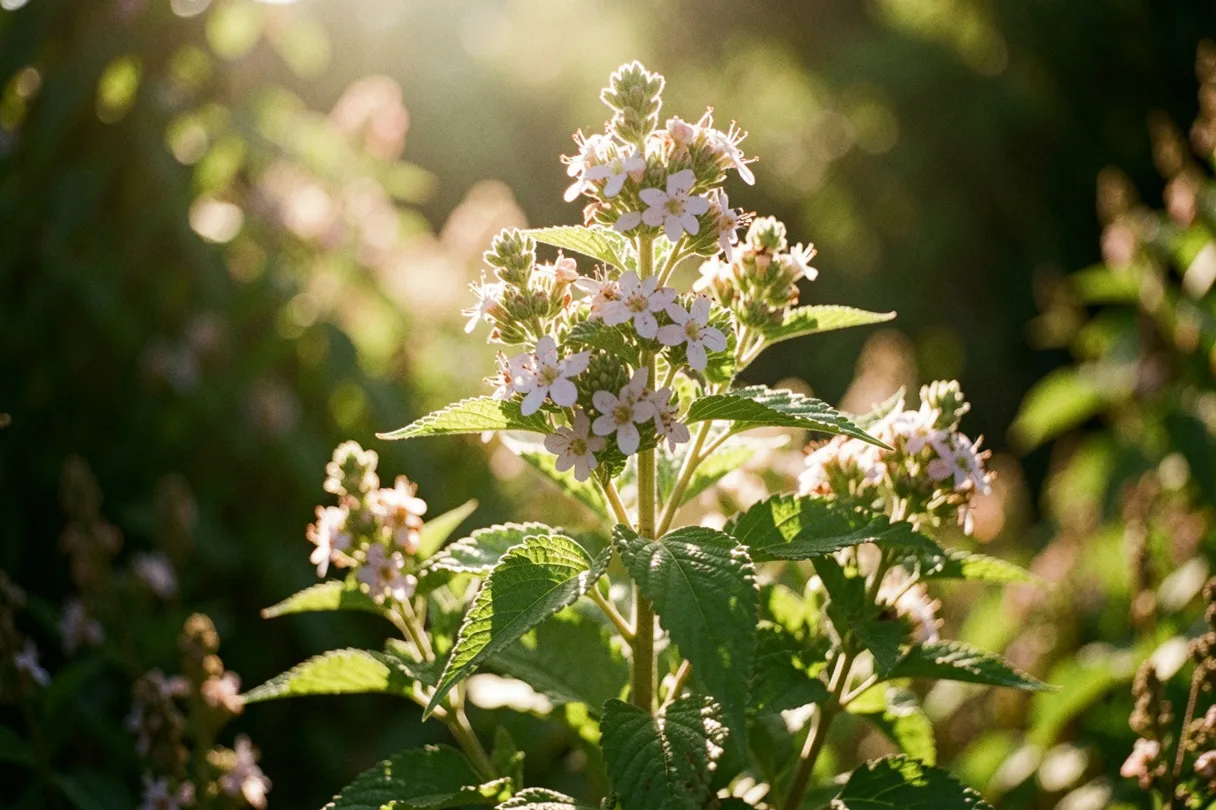
Sunlight delivers a continuous spectrum from ultraviolet (~280 nm) through visible light (380–700 nm) to near-infrared (700–780 nm). Plants have evolved to absorb specific portions of this spectrum through specialized pigments:
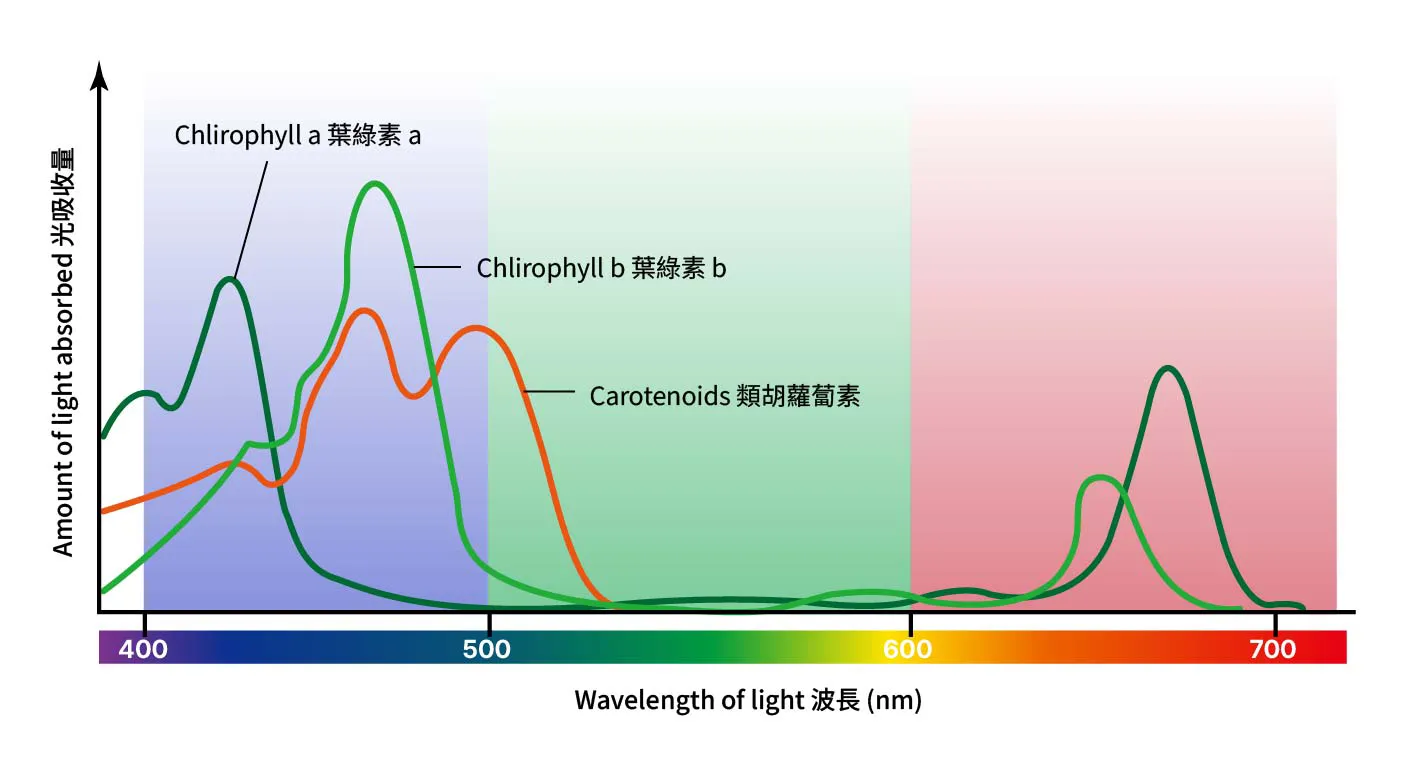
• Chlorophyll A: Peak absorption at ~430 nm (blue-violet) and ~680 nm (red)
• Chlorophyll B: Peak absorption at ~450 nm (blue) and ~640 nm (orange-red)
• Carotenoids: Absorb in the 400–500 nm range, supporting accessory light harvesting
• Phytochromes: Red/far-red photoreceptors regulating flowering, germination, and shade response
A well-designed plant grow light targets these absorption peaks precisely — delivering photon energy in the wavelengths plants can actually use, not simply replicating the visual appearance of sunlight. Advanced LED lighting for growing achieves this through combinations of phosphor-converted white LEDs, narrow-band blue LEDs (typically 450–460 nm), red LEDs (typically 630–660 nm), and in advanced systems, dedicated UV or green channels.
What Plants Actually Need: Understanding Light Spectrum
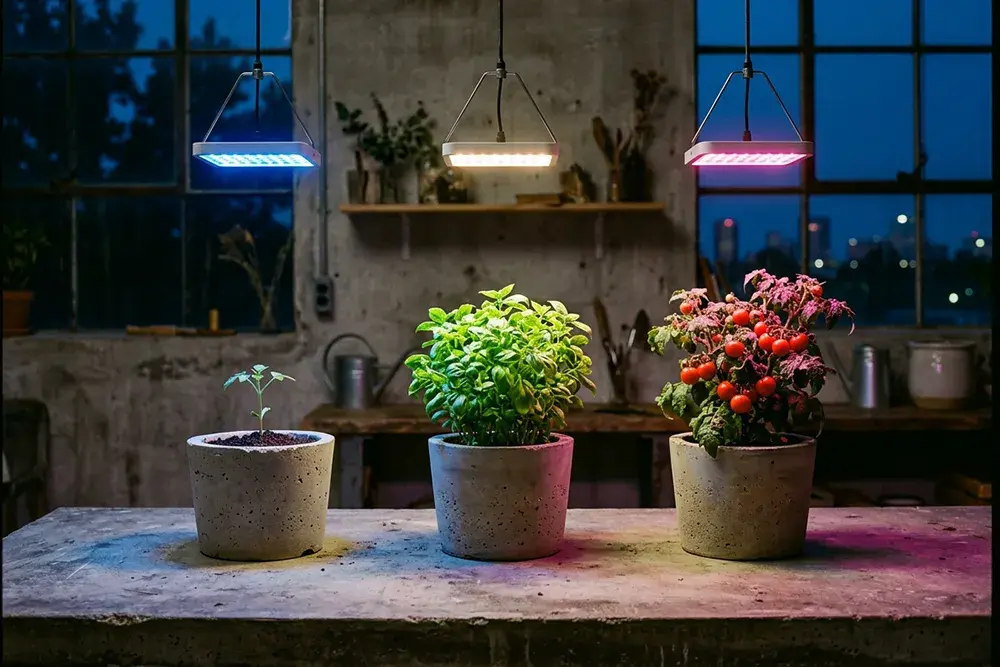
Blue Light (400–500 nm) — Vegetative Growth & Chlorophyll Development
Blue light is the primary driver of vegetative development. At the photoreceptor level, it activates cryptochrome and phototropin signaling pathways, which regulate stomatal aperture, leaf expansion, hypocotyl elongation inhibition, and phototropism. Chlorophyll shows strong uptake in the 430–450 nm range.
LED plant grow lights typically deploy narrow-band blue chips centered at 450–460 nm to maximize chlorophyll excitation efficiency. For commercial growers, blue light ratios in the 15–25% range of total PAR output are generally recommended for vegetative stages, with higher ratios up to 30–40% for propagation.
Red Light (600–700 nm) — Flowering, Fruiting & Photosynthesis
Red light in the 600–700 nm range represents the peak of photosynthetic efficiency for chlorophyll A and B combined — the band where quantum yield reaches its maximum. In LED plant grow light design, red chips centered at 660 nm are closer to the chlorophyll A absorption maximum and generally preferred for high-efficiency flowering applications.
Far-Red, UV & Full-Spectrum: Advanced Spectrum Engineering
Far-Red (700–750 nm): Far-red significantly amplifies red light's photosynthetic effect through the Emerson Enhancement Effect — simultaneous illumination at ~680 nm and ~730 nm produces more photosynthesis than the sum of either wavelength alone. Far-red also enables manipulation of flowering time and internode length.
UV (280–400 nm): Low-dose UV-A (315–400 nm) stimulates synthesis of anthocyanins, terpenes, and flavonoids. Precise dosimetry is critical — overdosing causes DNA damage and reduced yield.
Full-Spectrum LED Systems: A technically rigorous full-spectrum plant grow light delivers continuous output across 380–780 nm with specific enhancement peaks in blue (450–460 nm), red (630–660 nm), and far-red (730 nm), plus optional UV channels.
Key Metrics Every Grower and Engineer Must Know
PAR, PPFD, and PPF — Measuring Light That Plants Can Use
PAR (Photosynthetically Active Radiation): PAR is not a quantity but a spectral region — 400 to 700 nm — defining the wavelengths that drive photosynthesis. It is the qualitative boundary, not a measurement unit.
PPF (Photosynthetic Photon Flux): Measures the total photon output of a plant grow light per second across the PAR spectrum. Unit: µmol/s. Describes total light output, not what reaches the plant.
PPFD (Photosynthetic Photon Flux Density): Measures the photon flux arriving at a specific point per unit area per second. Unit: µmol/m²/s. This is the most operationally relevant metric — it describes what plants actually receive. A single PPFD value is insufficient; a full PPFD map showing peak intensity and spatial uniformity is the correct evaluation tool.
How to Measure True Plant Grow Light Efficiency (µmol/J)
PPE (Photosynthetic Photon Efficiency), expressed in µmol/J: calculated as PPF (µmol/s) ÷ Input Power (W). Current high-performance LED plant grow lights achieve 2.5–3.5+ µmol/J. PPE is the most important metric for total cost of ownership analysis. A fixture at 2.8 µmol/J versus 2.0 µmol/J will reduce electricity consumption by 28.5% for the same photon output — a difference that compounds significantly over 50,000+ operating hours.
Why Lumen and Lux Are the Wrong Units for Horticulture
Lumens and lux are weighted by the human eye's sensitivity curve, peaking at ~555 nm (green-yellow). Green light — which plants use poorly — is heavily weighted. Red light — which plants use most efficiently — is significantly underweighted. The practical conclusion: never compare plant grow lights using lux or lumens. Use PPFD for intensity and PPE for efficiency.
FAQ
High-quality LED plant grow lights carry an L70 lifespan rating of 50,000–100,000 hours — meaning light output remains above 70% of initial intensity for that duration. At 18 hours/day, this equates to approximately 7–15 years. Annual PPFD measurement at a fixed point is the most practical method for tracking performance over time.
Wattage is a poor primary metric. The correct approach: determine your target PPFD for the crop and growth stage (200–400 µmol/m²/s for seedlings; 400–600 for vegetative; 800–1,200+ for flowering), then calculate required PPF for your coverage area (PPFD × area in m²). Divide PPF by the fixture's PPE (µmol/J) to calculate required wattage.
Yes — in controlled environments, high-output LED plant grow lights can fully replace solar radiation for plant production. When analyzing the interaction between LED lights and growing plants, commercial vertical farms routinely achieve yields equal to or exceeding field production using LED-only illumination. Supplemental CO₂ enrichment (800–1,200 ppm) further enhances yield.
Q: How far should plant grow lights be from plants?
Optimal hanging distance is fixture-specific and must be determined from the manufacturer's PPFD distribution data. Remember the Inverse Square Law — doubling distance reduces PPFD to approximately one-quarter. Always verify with a PAR meter rather than relying solely on published data.