What Full Spectrum LED Plant Grow Lights Do at Every Plant Growth Stage

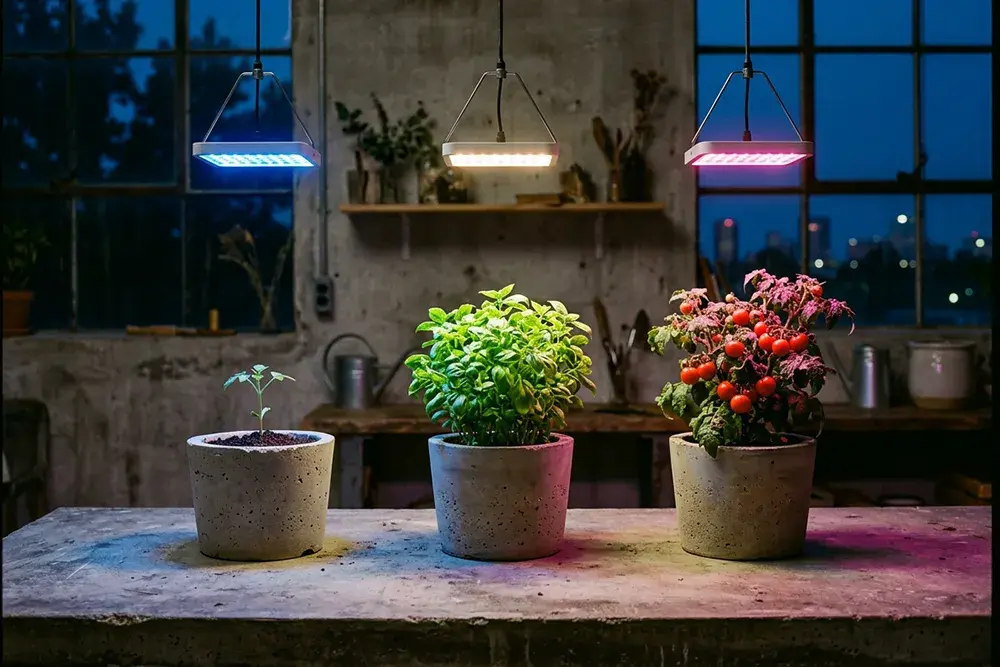
What Full Spectrum LED Plant Grow Lights Do at Every Plant Growth Stage
Full spectrum LED plant grow lights have become the industry standard for precision horticulture — but the term "full spectrum" is frequently misunderstood and inconsistently defined across the market. More importantly, applying full spectrum lighting requires a stage-by-stage strategy: running the same fixture at the same spectrum and intensity across all growth stages is a suboptimal approach.
This guide explains the photobiology behind full spectrum LED grow lights and provides actionable specifications for germination, vegetative growth, and flowering and fruiting stages.
What Is a Full Spectrum LED Plant Grow Light?
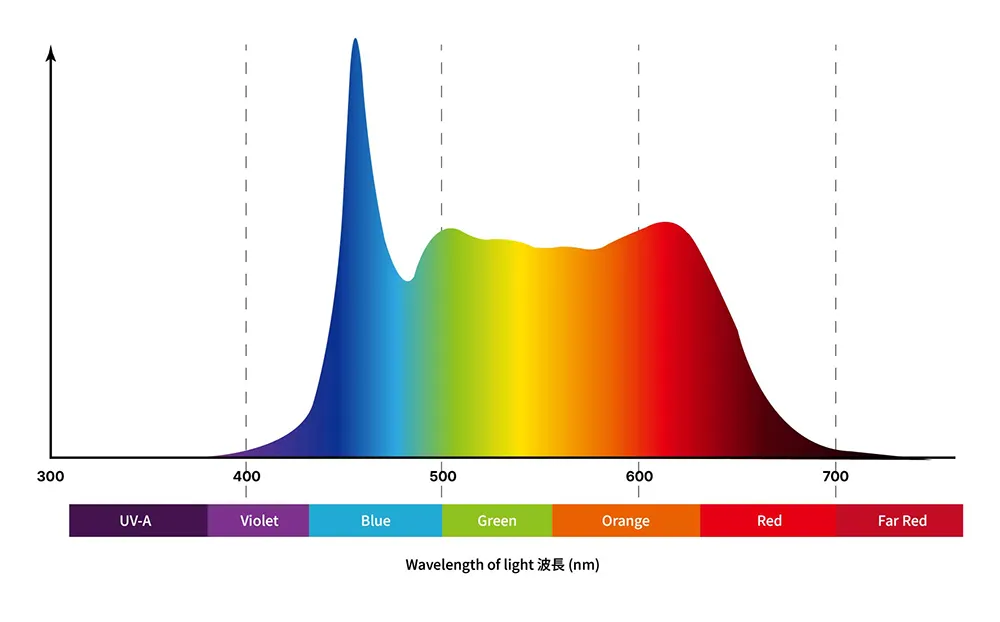
A full spectrum LED plant grow light is a fixture that emits light across the complete photosynthetically relevant wavelength range — typically 380 to 780 nm — with deliberate spectral engineering at key absorption peaks for chlorophyll and other plant photoreceptors.
Full Spectrum vs. Single-Band LED Plant Grow Lights: What's the Difference?
Single-band "blurple" fixtures (blue 450 nm + red 660 nm only) activate chlorophyll A and B efficiently but miss cryptochrome signaling, phytochrome responses, canopy penetration via green light, and human visibility for detecting visual stress symptoms.
Full spectrum LED plant grow lights cover all photoreceptors across 380–780 nm continuously. They provide high stage flexibility with tunable ratios, include green light (~500–600 nm) for canopy penetration and far-red (~700–750 nm) for phytochrome control, and are commercially suitable across all crop types.
| Feature | Full Spectrum LED | Single-Band (Blurple) LED |
|---|---|---|
| Wavelength range | 380–780 nm (continuous) | 450 nm + 660 nm only |
| Color rendering | White or white+color appearance | Purple/pink (blue+red only) |
| Stage flexibility | High (tunable ratio) | Limited |
| Green light inclusion | Yes (~500–600 nm) | No |
| Far-red inclusion | Yes (~700–750 nm) | Typically no |
| Commercial suitability | High | Limited (hobbyist/entry-level) |
What Wavelengths Are Included in Full Spectrum LED Plant Grow Lights?
| Wavelength Band | nm Range | Primary Function |
|---|---|---|
| UV-A | 315–400 nm | Secondary metabolite induction |
| Violet | 380–420 nm | Cryptochrome activation, anthocyanin |
| Blue | 420–490 nm | Stomatal regulation, vegetative compactness |
| Green | 490–560 nm | Canopy penetration, human color perception |
| Yellow-Orange | 560–620 nm | Moderate photosynthetic activity |
| Red | 620–700 nm | Peak photosynthetic quantum yield |
| Far-Red | 700–780 nm | Emerson Enhancement, phytochrome control |
Stage 1 — Germination & Seedling: How Blue Light Drives Root and Stem Development
The germination and seedling stage is characterized by rapid cell division, root architecture establishment, and the transition from seed energy reserves to photosynthetic self-sufficiency. Lighting at this stage must promote compact, robust plant structures while supporting chloroplast development.
Why Blue Light Dominates This Stage (400–500 nm)
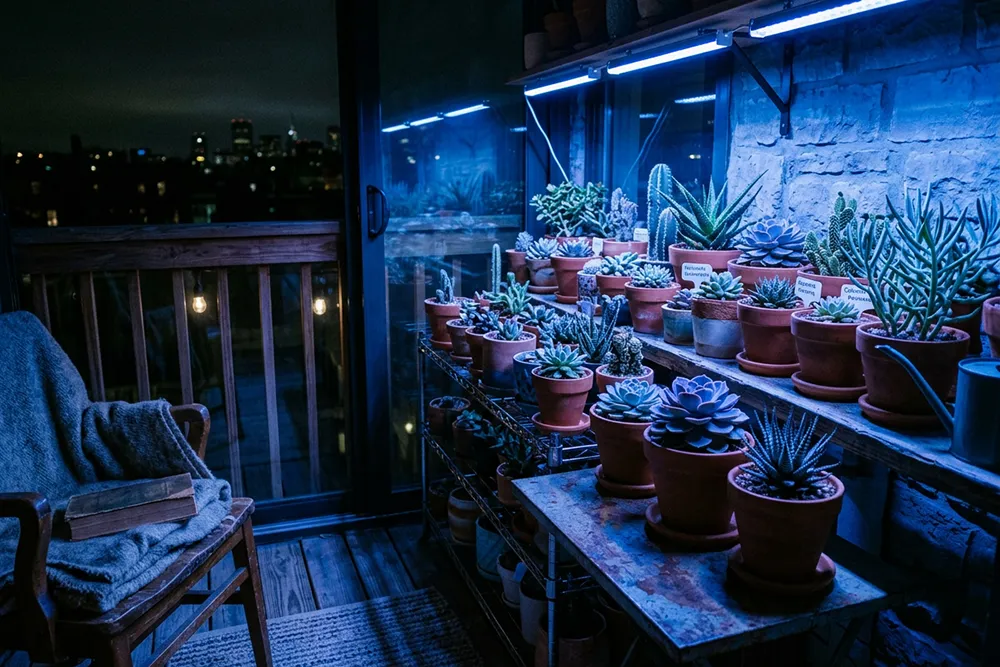
Blue light activates cryptochrome 1 and 2 (CRY1/CRY2), which regulate hypocotyl elongation inhibition (preventing etiolation), cotyledon expansion, chloroplast orientation, and root phototropism. In practical terms, a blue-enriched spectrum during germination produces shorter, stockier internodes; wider, darker green leaf blades; more robust root systems; and higher transplant success rates.
Recommended PPFD for Germination & Seedling: 200–400 µmol/m²/s
Germination (pre-emergence): 0–50 µmol/m²/s, photoperiod 0–16 hrs. Cotyledon emergence: 100–200 µmol/m²/s, 16–18 hrs. First true leaf: 200–300 µmol/m²/s, 16–18 hrs. Established seedling: 300–400 µmol/m²/s, 16–18 hrs.
Excessive PPFD during early seedling stages — particularly above 600 µmol/m²/s — can cause photoinhibition and bleaching before the plant's photoprotection mechanisms are fully established.
Why 5000K–6500K Works Best in This Stage
A 5000K–6500K white LED provides higher blue content (approximately 25–35% of PAR output in the 400–500 nm range), a lower red:blue ratio that suppresses premature stem elongation, and broad green coverage supporting canopy penetration and human visual inspection. For commercial propagation facilities, 6500K-calibrated white LED channels combined with dedicated 450 nm deep-blue LEDs provide the optimal seedling spectral environment.
Stage 2 — Vegetative Growth: How to Maximize Canopy Development with Balanced Spectrum
Vegetative growth is characterized by rapid biomass accumulation, leaf area expansion, and structural development of the plant framework. The lighting strategy shifts toward supporting high photosynthetic rates while maintaining compact, branching architecture.
Blue + Green Synergy for Leaf Morphology and Chlorophyll Efficiency
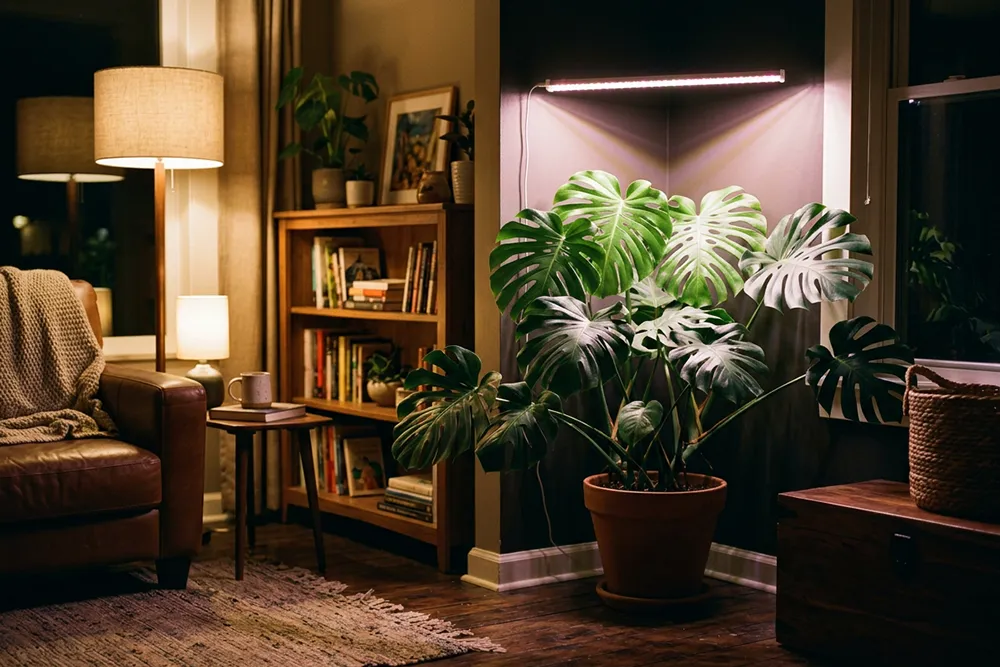
Green light (500–600 nm) — long dismissed as non-photosynthetically useful — plays a critical role in whole-canopy photosynthesis. It penetrates 3–5 lower leaf layers compared to blue or red light, activates shade leaves that receive minimal blue/red, fine-tunes stomatal aperture and CO₂ uptake, and increases canopy-level photosynthesis by 10–20% compared to blue+red only.
Deploying optimized LED lighting for growing at this stage balances approximately: 20–25% blue (400–500 nm), 15–20% green (500–600 nm), 55–65% red (600–700 nm), with optional 5–10% far-red.
Recommended PPFD for Vegetative Growth: 400–600 µmol/m²/s
Leafy greens (lettuce, spinach): 150–300 µmol/m²/s. Herbs (basil, cilantro): 250–400 µmol/m²/s, blue-rich spectrum for compactness. Cannabis (vegetative): 400–600 µmol/m²/s, high DLI target, supplemental CO₂ beneficial. Tomatoes/Cucumbers (veg): 300–500 µmol/m²/s, broad-spectrum includes green. Strawberries (runner production): 200–350 µmol/m²/s, moderate, controlled photoperiod.
Light Duration and Photoperiod Control for Commercial Operations
DLI = PPFD (µmol/m²/s) × Hours × 3600 ÷ 1,000,000. Target DLI ranges: Lettuce 12–17 mol/m²/day; Basil 15–20 mol/m²/day; Cannabis (vegetative) 25–40 mol/m²/day; Tomatoes (greenhouse) 20–30 mol/m²/day. For photoperiod-sensitive crops, even brief light interruptions (1–2 minutes of red light exposure) during the dark period can prevent flowering in short-day plants.
Stage 3 — Flowering & Fruiting: How Red and Far-Red Spectrum Boost Yield
The transition to reproductive growth requires a fundamental spectral shift. Plants entering the flowering and fruiting stage have different photobiological requirements that full spectrum LED plant grow lights are uniquely positioned to address.
Red Light (620–700 nm) and the Emerson Effect with Far-Red (700–750 nm)
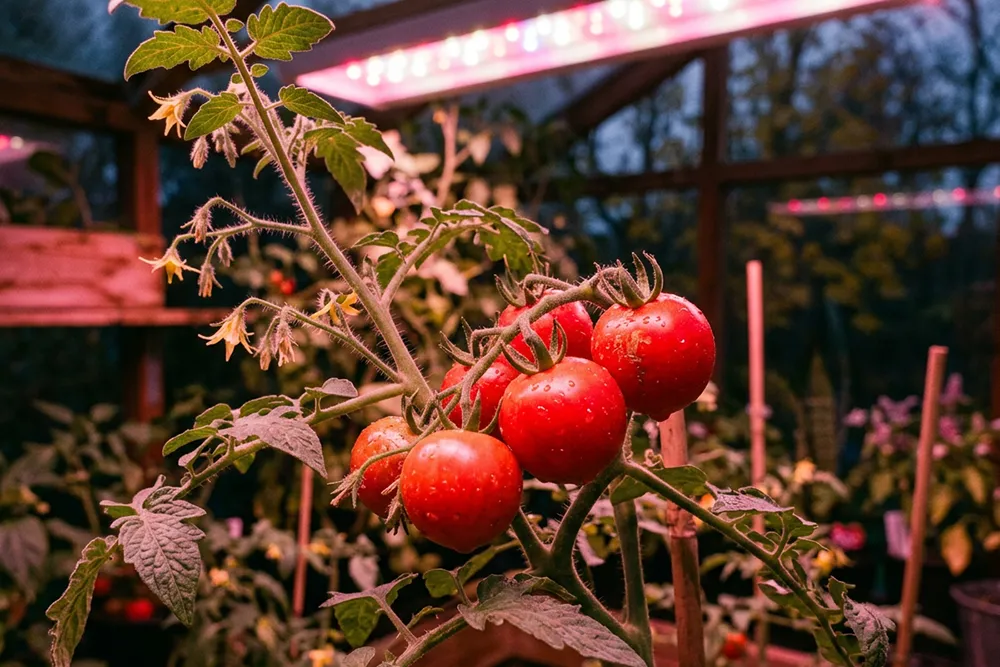
Red light (620–700 nm) drives the highest quantum yield of photosynthesis in both chlorophyll A and B. During flowering and fruiting, it maintains plants in the active Pfr state, supports sustained metabolic activity, and the higher red:blue ratio promotes internode extension that supports flower site development.
The Emerson Enhancement Effect: when plants receive simultaneous illumination at ~680 nm (red) and ~730 nm (far-red), their photosynthetic rate exceeds what either wavelength would produce independently. Far-red activates Photosystem I (PSI) while red activates Photosystem II (PSII), and optimal photosynthesis requires balanced throughput in both systems. Adding 5–15% far-red to a red-dominant flowering spectrum can increase net canopy photosynthesis by 10–25% — significant yield enhancement without proportional energy increase.
Recommended PPFD for Flowering & Fruiting: 800–1,200 µmol/m²/s
Cannabis (flowering): 800–1,200 µmol/m²/s, CO₂ enrichment to 1,000–1,500 ppm recommended. Tomatoes (fruiting): 600–900 µmol/m²/s, interlight positioning for lower canopy. Strawberries (flowering): 400–600 µmol/m²/s, far-red supplementation beneficial. Peppers (fruiting): 500–800 µmol/m²/s, high temperature management critical. Cucumbers (fruiting): 500–900 µmol/m²/s, high DLI, interlight recommended.
UV Supplementation for Plants: Enhancing Terpene, Resin, and Nutritional Value
UV supplementation (280–400 nm, particularly UV-A at 315–400 nm) triggers plant stress responses that result in increased synthesis of terpenes and terpenoids (in cannabis, UV stress at 3–4 weeks before harvest can increase terpene concentration by 15–30%), cannabinoids (THC, CBD), anthocyanins, and flavonoids and polyphenols
Effective UV supplementation uses 3–10 W/m² of UV-A for defined exposure periods (typically 2–4 hours/day during the final 2–4 weeks of the crop cycle), rather than continuous low-level exposure.
FAQ
Distance must be determined from manufacturer PPFD distribution maps calibrated to your target PPFD for the current growth stage. Germination: position for 200–400 µmol/m²/s; vegetative: 400–600 µmol/m²/s; flowering: 800–1,200 µmol/m²/s. Light intensity decreases with the square of distance — verify with a PAR meter. Most commercial full spectrum LED plant grow lights are designed for 45–75 cm hanging heights for flowering crops.
Yes, in controlled environments with adequate PPFD levels. When evaluating the overall impact of LED lights and growing plants, modern full spectrum LED systems can deliver the complete photonic and spectral requirements for plant growth across all stages. Commercial vertical farms and sole-source LED facilities regularly achieve crop performance equal to or exceeding field production. CO₂ enrichment to 800–1,200 ppm further enhances yield under high-intensity LED conditions.
Seedlings: 16–18 hours. Vegetative growth: 18/6 is standard. Photoperiod-sensitive flowering crops: 12 hours (12/12). Day-neutral crops and autoflowering varieties: 18–20 hours throughout. Consult DLI targets for your specific crop — for example, cannabis in vegetative growth requires 25–40 mol/m²/day DLI, which at 400–600 µmol/m²/s requires 18+ hours of illumination.