How to Choose LED Plant Grow Lights: Comparing Types, Specs, and Commercial Applications

How to Choose LED Plant Grow Lights: Comparing Types, Specs, and Commercial Applications
Selecting the right LED plant grow light for a commercial operation is an engineering decision, not a consumer purchase. The difference between a well-specified system and a poorly chosen one can mean the difference between profitable yields and chronic underperformance — regardless of how much was spent on the fixtures themselves. This guide provides a rigorous framework for comparing plant grow light technologies, evaluating technical specifications, and matching LED solutions to real-world commercial growing environments.
What Are the Differences Between Plant Grow Lights: LED, HPS, MH, and Fluorescent
The plant grow light market has transitioned significantly over the past decade. Understanding the comparative strengths and limitations of each technology is essential for making defensible procurement decisions.
| Specification | LED | HPS | MH | 螢光燈(T5/T8) |
|---|---|---|---|---|
| Efficacy (µmol/J) | 2.0–3.5+ | 0.9–1.2 | 0.8–1.1 | 0.6–1.0 |
| Lifespan (hours) | 50,000–100,000 | 10,000–24,000 | 6,000–20,000 | 20,000–30,000 |
| Heat Output | Low (remote driver) | Very high (radiant) | High (radiant) | Low–moderate |
| Spectrum Control | Full (tunable) | Fixed (HPS spectrum) | Fixed (MH spectrum) | Limited |
| IP Rating | Up to IP66+ | Typically IP54 | Typically IP44 | Varies |
Energy Efficiency and Heat Dissipation of LED Grow Lights
LED plant grow lights achieve their efficiency advantage through two mechanisms: higher photon conversion efficiency and directional light delivery.
Conventional HPS fixtures radiate heat in all directions and require significant HVAC capacity to maintain optimal growing temperatures — typically adding 15–25% to operational energy cost beyond the fixture consumption itself.
When switching to advanced LED lighting for growing, these systems emit far less heat per photon produced. At 2.5–3.5 µmol/J versus HPS at 0.9–1.2 µmol/J, a LED system can produce the same photon output with 30–65% less electricity consumed. In large-scale operations with 500+ fixtures running 18 hours/day, this differential represents substantial annual operating cost savings.
Lifespan, Maintenance Cost, and IP Rating of LED Grow Lights
HPS and MH lamps require replacement every 1–2 years (10,000–24,000 hours) to maintain adequate output — accounting for both bulb replacement cost and labor. LED systems, rated at 50,000–100,000 hours to L70, require no bulb replacement and minimal maintenance within a 5–10 year operational window.
IP (Ingress Protection) ratings are particularly important in greenhouse and vertical farm environments where irrigation, high humidity, and cleaning protocols expose fixtures to moisture. Relevant IP ratings:
• IP54: Protected against limited dust ingress and water splashing from any direction
• IP65: Dust-tight, protected against water jets — minimum recommended for greenhouse use
• IP66: Dust-tight, protection against powerful water jets — recommended for food production and washdown environments
• IP67+: Full immersion protection — required for aquaponic or high-moisture applications
Spectrum Controllability: The Advantage of LED
This is where LED technology holds an irrefutable advantage over HPS, MH, and fluorescent systems. Fixed-spectrum technologies emit a static spectral output that cannot be modified — growers must choose a lamp for either vegetative (MH) or flowering (HPS) stages, often requiring fixture swaps between growth phases.
Modern LED plant grow light systems with multi-channel control allow:
• Dynamic spectrum adjustment — shifting blue:red:far-red ratios at any point in the crop cycle
• Photoperiod manipulation — using far-red supplementation to accelerate or delay flowering
• Stage-optimized recipes — programmed spectrum profiles for germination, vegetative, pre-flower, and fruiting stages
• Emergency UV dosing — targeted secondary metabolite induction at specific growth windows
• Dimming capability — PPFD reduction for sensitive plants or high-temperature periods without spectrum distortion
What Are the Commercial Applications of LED Grow Lights
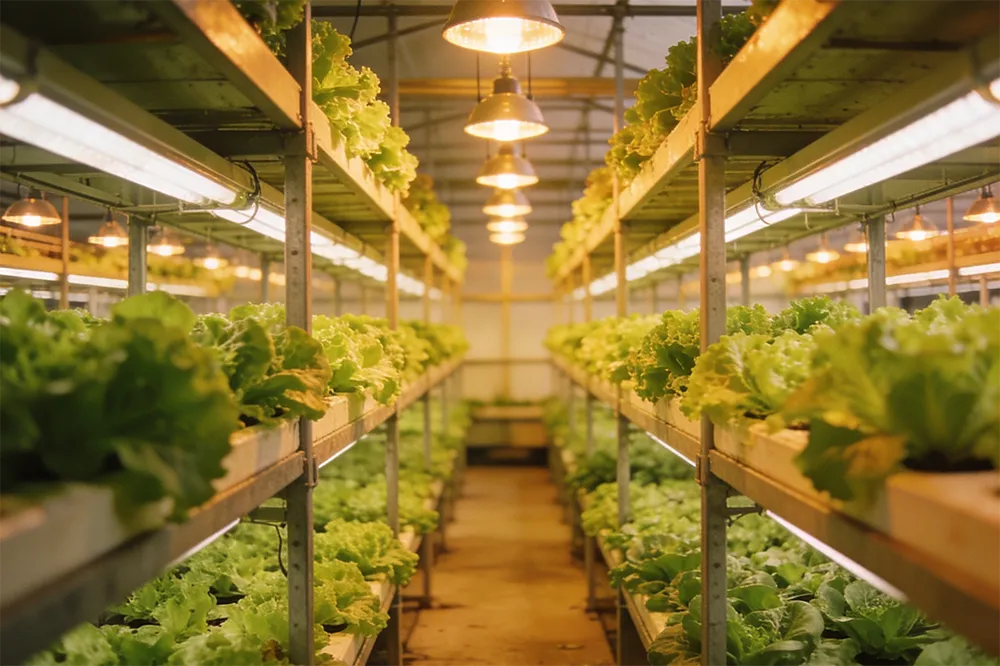
Vertical Farming & Multi-Tier Indoor Farms
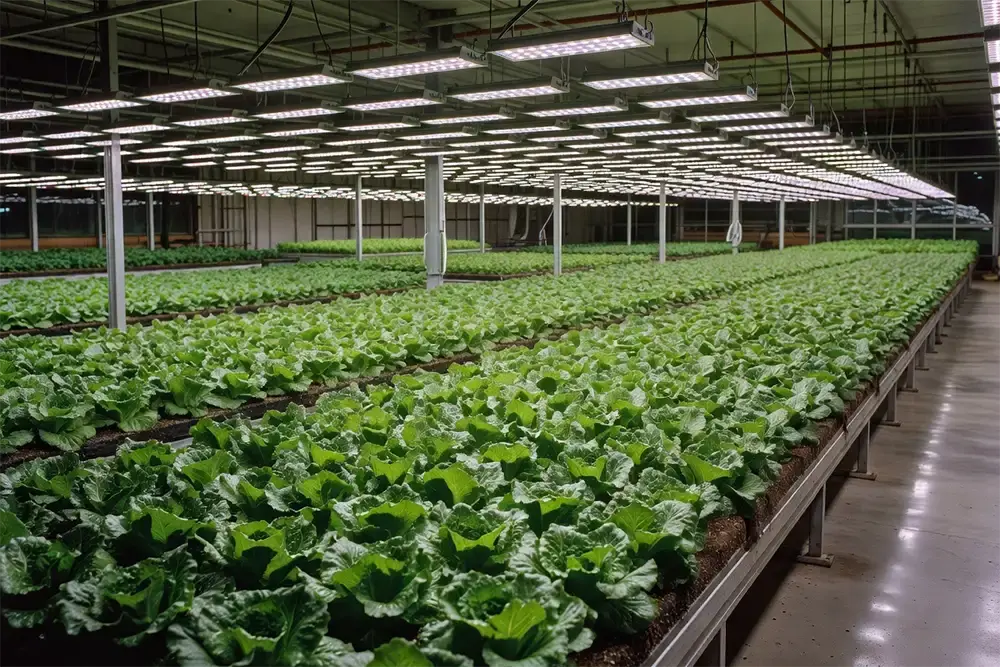
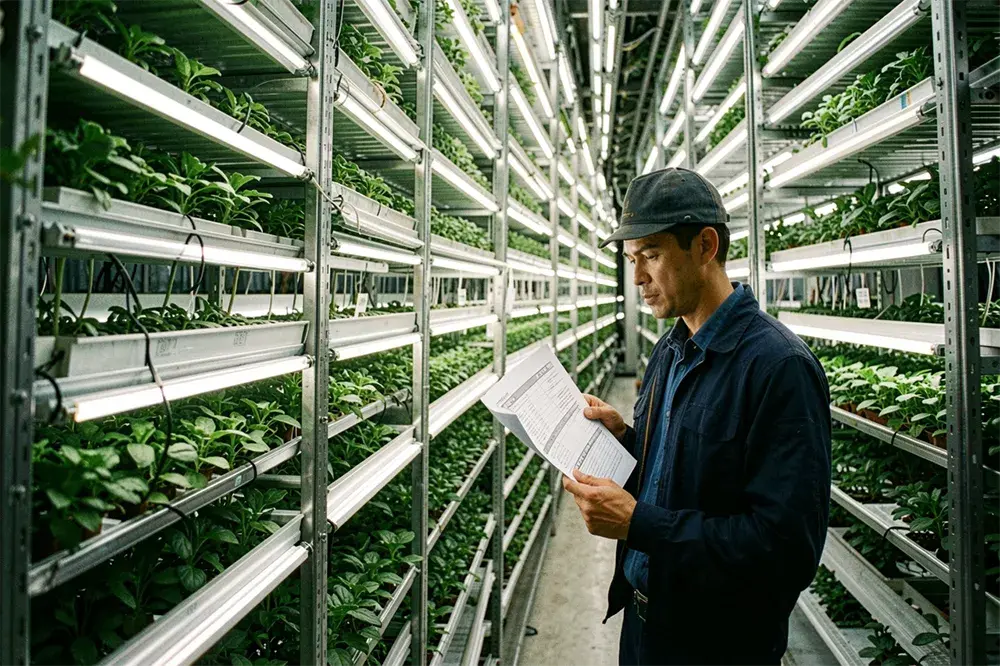
Vertical farming represents the most demanding environment for plant grow light specification. Key requirements include:
• Low heat output: Multi-tier structures have limited airflow; excessive heat radiated downward onto lower tiers disrupts growing conditions
• High PPE: Electricity is the dominant operating cost in vertical farms; systems below 2.5 µmol/J are difficult to operate profitably
• Slim form factor: Fixture depth and geometry must accommodate tight inter-tier spacing (typically 40–80 cm)
• Uniformity: PPFD uniformity ≥85% across the crop area is critical for consistent growth across all positions
• Spectrum control: Different crops on different tiers may require independent spectral tuning
For vertical farms, bar-style LED plant grow light fixtures with high uniformity and low profile depth are the dominant format. Systems rated at 2.6–3.2+ µmol/J are commercially standard for Tier 1 operators.
Greenhouse Supplemental Lighting
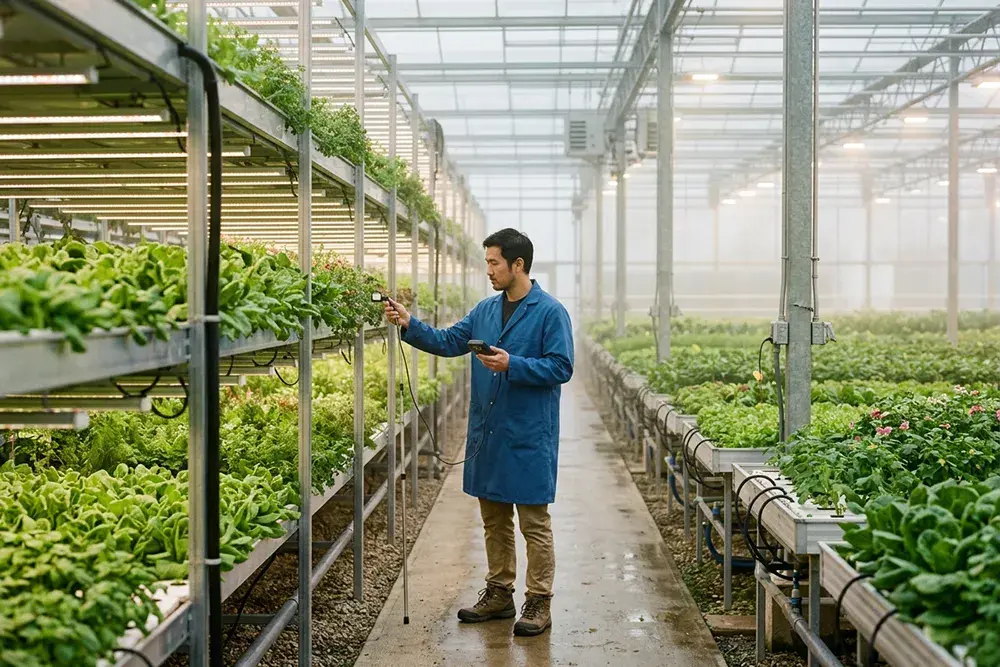
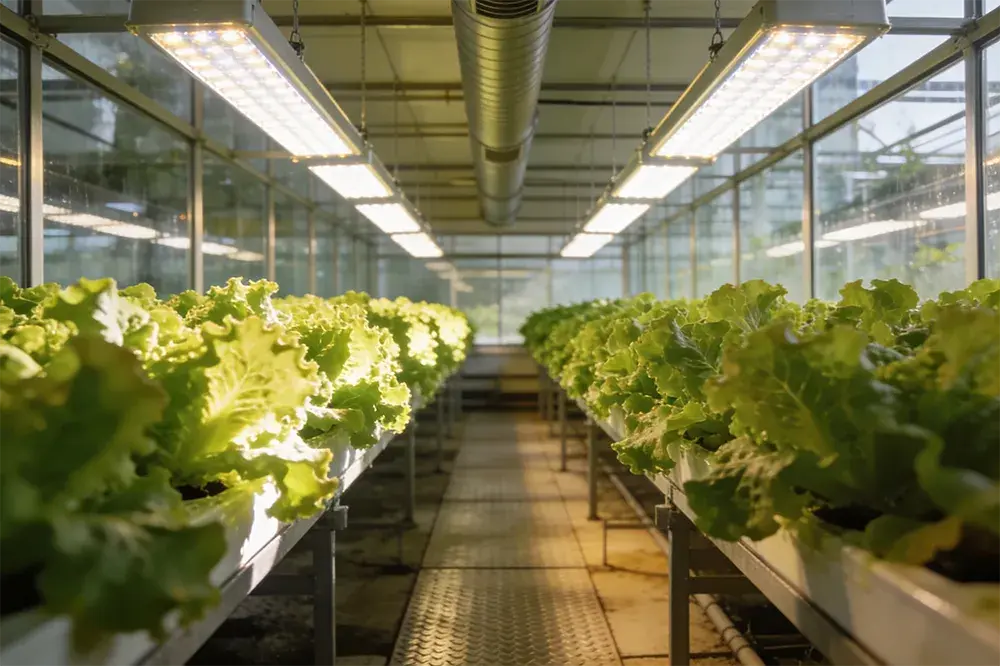
In greenhouse applications, LED plant grow lights supplement natural solar radiation during:
• Low-light winter periods (northern latitudes)
• Overcast conditions where DLI (Daily Light Integral) falls below crop thresholds
• Night extension or day-neutral lighting programs
Supplemental lighting requirements differ from sole-source: fixtures must deliver additional PPFD above ambient solar levels without overheating the greenhouse canopy. Interlight systems (positioned within the crop canopy rather than overhead) are commonly used in high-wire tomato and cucumber production.
Key greenhouse specifications:
• Corrosion resistance for humid, chemically active environments
• Wireless dimming integration with solar radiation sensors (lighting control systems that reduce artificial PPFD as natural light increases)
• IP65 minimum rating
• Wide-angle beam optics to maximize canopy coverage from overhead positions
Controlled Environment Agriculture & Hydroponics
CEA (Controlled Environment Agriculture) encompasses a wide range of facilities from research growth chambers to commercial hydroponic operations. LED plant grow lights in CEA applications must address:
• Precision PPFD delivery: Research environments require ±5% PPFD uniformity; commercial hydroponic operations target ±10–15%
• Long-term stability: Output consistency over 50,000+ hours is critical for reproducible crop performance
• Integration with environmental control systems: CO₂ enrichment, VPD management, and nutrient delivery systems must be coordinated with lighting schedules
• Modular design: Scalable fixture configurations that can expand with facility growth
How to Select the Right LED Grow Light for Your Operation
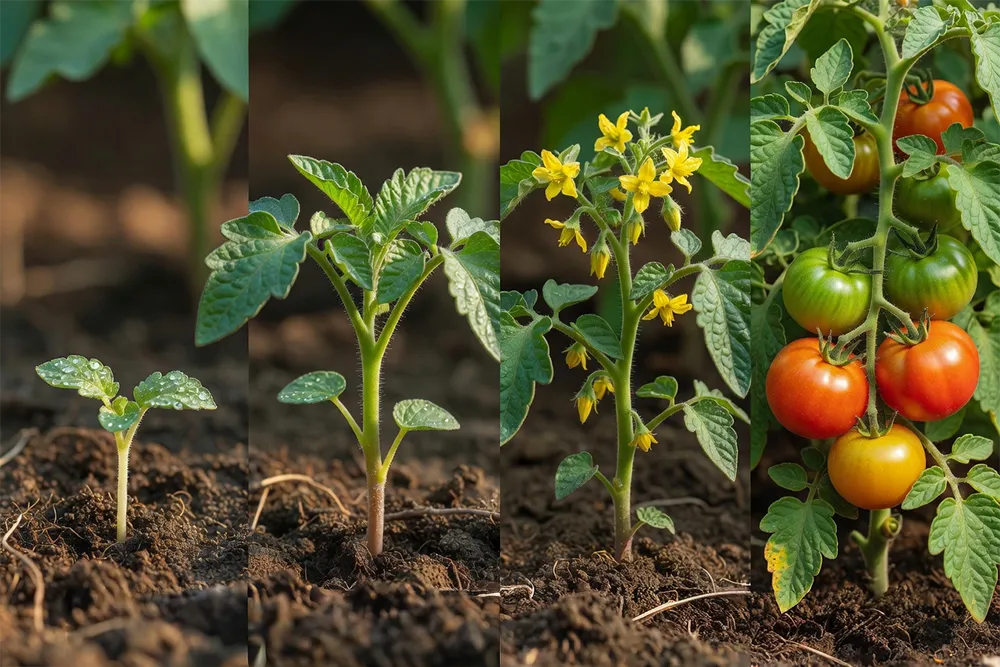
Matching Spectrum and PPFD to Crop Type and Growth Stage
| Crop | Growth Stage | Target PPFD (µmol/m²/s) | Spectrum Priority |
|---|---|---|---|
| Lettuce / Leafy Greens | Full cycle | 150–300 | Balanced blue:red (1:3–1:5) |
| Herbs (basil, mint) | Full cycle | 200–400 | Higher blue (compactness) |
| Cannabis | Vegetative | 400–600 | Blue-dominant (450–460 nm) |
| Cannabis | Flowering | 800–1,200 | Red-dominant + far-red |
| Tomatoes | Vegetative | 300–500 | Balanced + green |
| Tomatoes | Fruiting | 600–900 | Red-dominant |
| Strawberries | Flowering | 400–600 | Red + far-red |
| Microgreens | Full cycle | 150–250 | Broad spectrum |
Wattage, Coverage Area, and Thermal Management for Plants
Coverage area calculations must account for PPFD uniformity, not just average intensity. A fixture delivering 800 µmol/m²/s at the center with rapid falloff to 300 µmol/m²/s at the edges creates a 0.5 m² high-performance zone surrounded by a deficient perimeter — an unacceptable uniformity profile for commercial production.
Thermal management in LED plant grow light design directly affects both performance and longevity:
• LED junction temperature must remain below 85°C for rated lifespan; exceeding this accelerates lumen depreciation
• Passive heat sink designs (no moving parts) are preferred for reliability in agricultural environments
• Driver placement affects heat distribution — remote drivers isolate heat from the plant canopy
• Facilities in high-ambient-temperature environments should specify fixtures with tested thermal performance at operating temperature, not just at standard test conditions (25°C)
FAQ
Spectrum controllability allows growers to deliver the precise wavelength combination that each crop requires at each growth stage — blue-dominant light for compact vegetative growth, red-enriched spectrum for flowering and fruiting, far-red supplementation for Emerson Enhancement Effect and photoperiod manipulation, and UV dosing for secondary metabolite induction. Fixed-spectrum HPS or MH systems cannot be adjusted and require physical lamp changes to shift between vegetative and flowering applications. Controllable LED plant grow light systems eliminate this limitation and enable continuous optimization as crop science evolves.
LED junction temperature directly governs both photon output efficiency and long-term lumen maintenance. Fixtures operating at high junction temperatures due to inadequate thermal design will show accelerated lumen depreciation (faster L70 degradation), color shift over time, and reduced overall lifespan. In commercial growing environments, heat dissipation also affects the HVAC load — high-heat fixtures increase cooling requirements, which directly adds to operating costs. Well-designed LED plant grow lights with high-efficiency thermal management maintain junction temperatures within specification across all ambient operating conditions, ensuring consistent PPFD delivery over 50,000+ hours.
No — and this equivalency claim is one of the most misleading in the plant grow light market. The comparison is meaningless because output is not determined by wattage but by PPFD delivery and spectral composition.
When comparing the physics of LED lights for growing plants, a quality 600W LED system with 2.8 µmol/J PPE will typically deliver more plant-usable photons than a 1000W HPS operating at 1.1 µmol/J. The correct comparison requires PPFD maps at a defined hanging height with uniformity data and spectral output included. Any vendor relying on wattage equivalency claims rather than PPFD data should be approached with caution.